
We help manufacturers integrate technology into how their business actually works.
A managed IT services company based in SE London. We specialise in IT–OT integration and cybersecurity for businesses with 25 to 250 people — technology grown through the business, not bolted on top of it.

Two worlds joined by accident, never by design.
Most manufacturers run IT and OT as two separate worlds — different teams, different suppliers, different rules — quietly sharing one network that nobody governs. The result is friction: technology installed rather than integrated, security that looks configured on paper but isn't genuinely effective, and operational decisions made without a clear picture of what the technology is doing. We fix the foundations first — then make sure technology grows with the business rather than holding it back.
Manufacturers who want a partner, not a support desk.
Our primary clients are manufacturers with 25–250 employees in London. We're not the right fit for everyone — the clients we work best with want technology genuinely integrated into how they operate, not a number they call when something breaks.
The best technology is nearly invisible. It empowers without getting in the way.
When components in any system are truly integrated — grown together, developed as one thing — the whole works far better than the sum of its parts. When they're bolted on, they become obstacles. A central nervous system coordinates the body invisibly and continuously; it carries signals, responds to change, and develops alongside the body it serves. Technology should work the same way. When this works properly, the brain stops thinking about breathing. Leadership leads. Production produces. The technology disappears.
Security, identity, email, collaboration, networking, backup. Systematic, automated, invisible. If this layer generates conversation, something is wrong.
Not a support desk — a co-decision-making function. We're present when technology decisions are being made, not called in after. The 10% that's unique to your business.
A team that learned systems thinking from engineering — and applies it to technology.
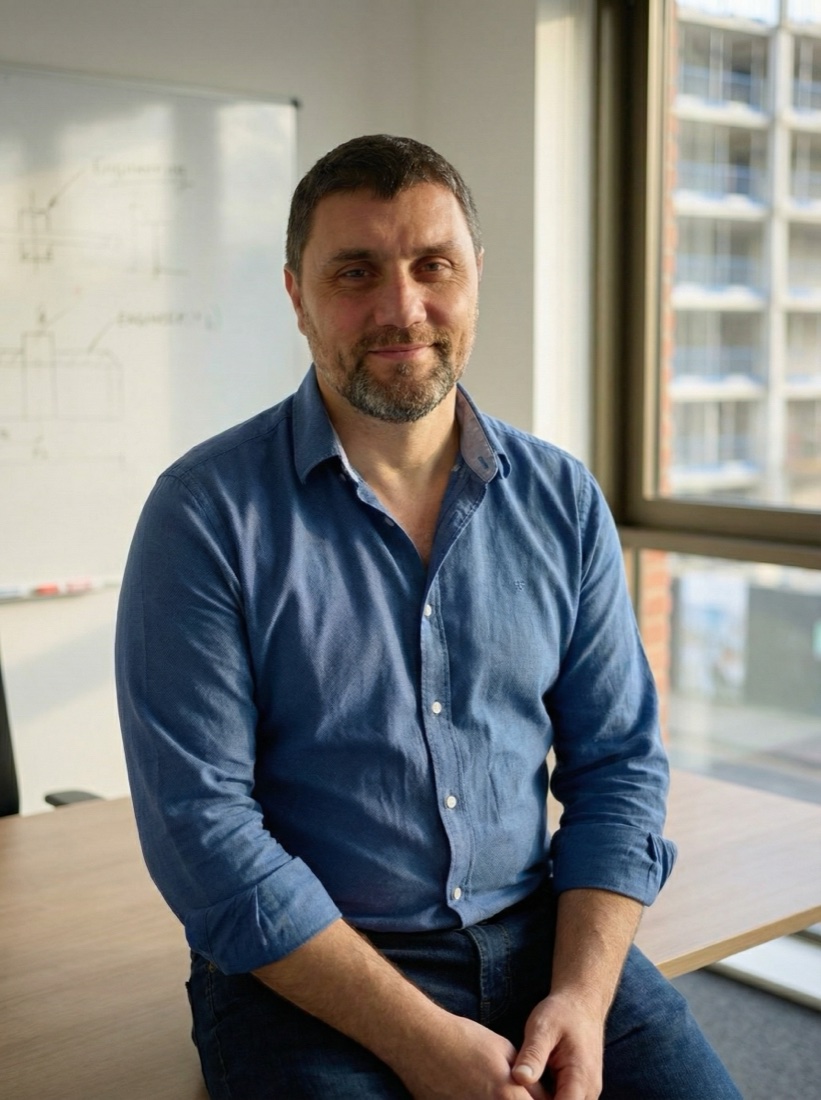
Jay Bodys
Jay founded NBS in 2003 with an MSc in Automatics and Robotics from the Technical University of Wrocław — foundations in manufacturing systems, control theory, and industrial automation. That engineering training is why NBS thinks in systems rather than services, and why the approach starts with how a business operates before anyone discusses tools.
Over 22 years, Jay has worked with businesses from startup through to acquisition — relationships that begin at 15 employees and continue through growth to 250, through corporate acquisition, and beyond. He holds qualifications in IT–OT Integration and Operational Technology Security, and works directly with every NBS client at the strategic level.
What happens when IT…
Maybe you want to build something and sell it. Maybe you want to build something that lasts. Maybe you just want to build something that works — something substantial, maybe even a legacy. It doesn't matter which. You will need belief strong enough to crystallise into a vision you can put on paper, and a message clear enough that other people feel it too.
What nobody tells you early enough: you will need people, and people are different. Two brains are never the same. Your job as a leader is not to make people think like you, it is to build systems that let them open their wings. And those systems are needed far earlier than anyone expects.
We learned this over ten years inside a business that grew from 15 people to over 250, and was eventually acquired by a global group.
We were one of the first things that business invested in. Before a finance director. Before HR. Before an IT manager. They brought in IT, integrated, not bolted on, because they believed it would give the business its wings. And it did.
…is integrated from the start?
IT gave them the ability to systemise, standardise, and communicate, internally and externally. It reduced friction so the owners could focus on what they were passionate about. As the business grew, every role that followed — finance, HR, operations — was built on foundations that were already documented, already managed, already working.
Problems were caught before they became problems. When something broke in one place, the fix was already known everywhere else. Documentation meant nobody's holiday created a crisis. Standardisation meant fewer fires. And only then, with all of that underneath, could automation actually work.
By the end, change was managed and controlled. Every surface of the business looked like what it was: an attractive, well-run operation. And it sold.
The technology we built was kept. Not replaced. We consider that the clearest measure of genuine integration.
Your business is somewhere on this journey.
Six ingredients. The order matters.
Integration requires maturity to develop. Skip a step and you build on sand — automate without documentation and training underneath, and failures become silent.
When something goes wrong, there is one team to call: us.
A typical IT setup means Microsoft blaming the network, the network blaming security, and security blaming Microsoft. The result is wasted time, unresolved problems, and gaps at the boundaries between vendors.
We built it. We manage it. We're responsible for it. We don't consult on things we don't do ourselves — we run our own operations on these exact systems and processes. That's the only way to guarantee the advice is honest.
What is IT–OT integration and why does it matter for manufacturers?
IT runs your business — email, accounts, files. OT runs your production — machinery, control systems, sensors. They were never designed to share a network, yet in most manufacturers they do: not by decision, but because the business grew and everything ended up on the same wires. So the two worlds are separate in every way that doesn’t help — different teams, different suppliers, different rules — and joined in the one way that hurts: one ungoverned network, where a problem in the office can reach the line.
Integration is not merging them. It is designing the relationship: office and production each in their own zone, with a controlled, watched boundary between them — so data crosses on purpose, and problems don’t cross at all. Nothing shared by accident. Everything connected by design.
What does "integrated not installed" mean?
Technology grown through a business rather than added on top of it. Installed technology creates friction — it needs maintenance, workarounds, and constant attention. Integrated technology becomes invisible because it works correctly. When IT is working properly, nobody notices it. That is the objective.
Does NBS work with businesses outside London?
Our primary focus is manufacturers in London, but we also work with clients outside it. For the right client with the right fit, we are flexible. Contact us to discuss your situation.
What is the Business Technology Alliance?
The BTA is the strategic 10% — where technology decisions are made alongside the business rather than for it. Foundation IT (the 90%) runs invisibly. The BTA is where we act as co-decision maker on technology direction, reviewing what exists, planning what comes next, and ensuring change is managed rather than improvised.
How do I know if NBS is the right fit for my business?
If you are a manufacturer in London with 25 to 250 people, if you have had IT that was installed rather than integrated, and if you want a provider who will tell you how they think rather than just what they charge — we are probably worth a conversation.